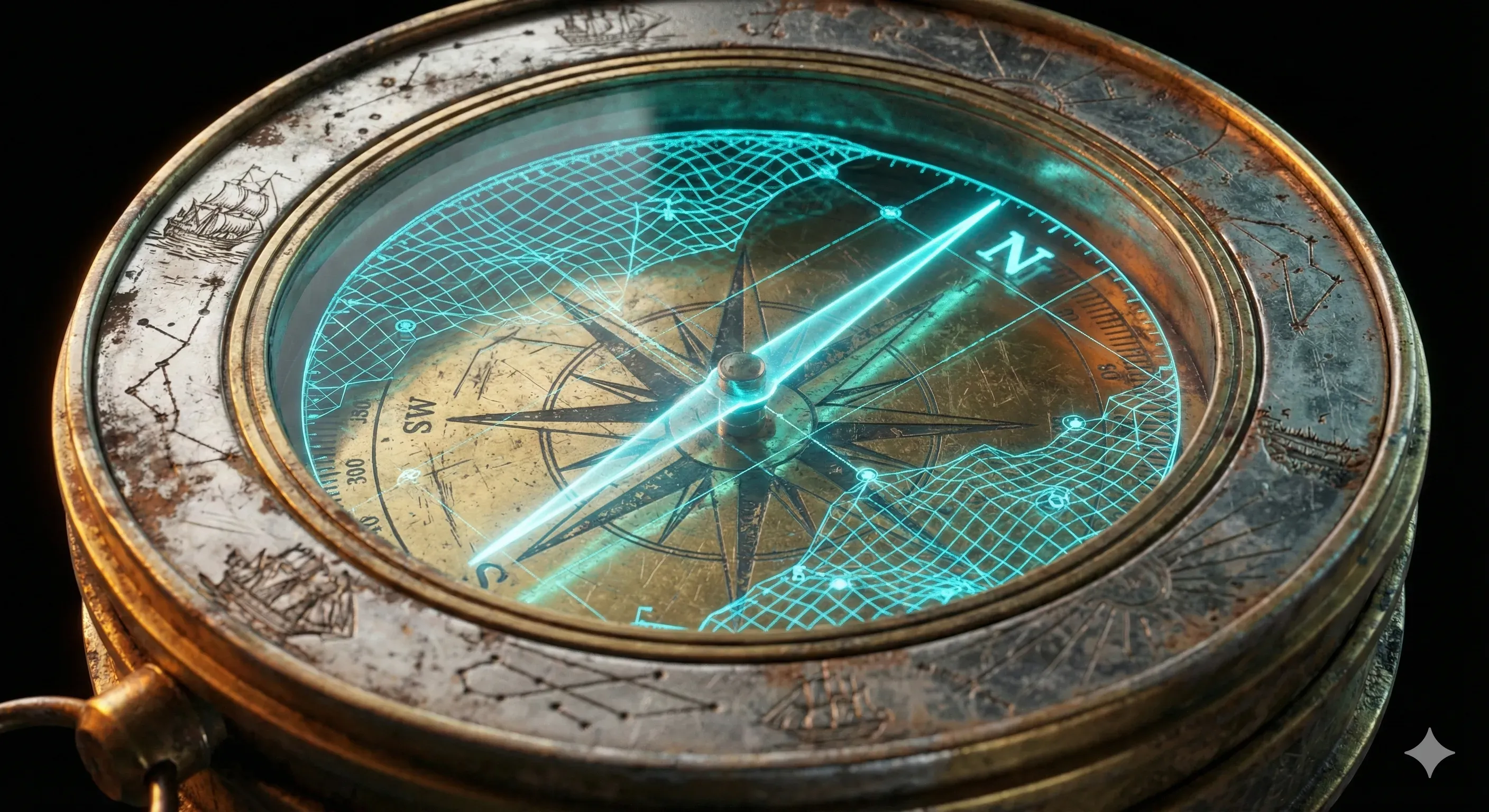
The Isomorphic Atlas
The Topology of Time: On the Method of Structural Isomorphism. A weekly series exploring the historical rhymes of synthetic intelligence.
The fundamental error of the present moment is the belief that it has no history. We are surrounded by a rhetoric of “The Singularity”—a breathless, messianic conviction that the arrival of Synthetic Intelligence represents a rupture in the timeline, an event so novel and so absolute that the laws of the past no longer apply.
This Atlas rejects that premise. It operates on a darker, more thermodynamic assumption: History does not repeat, but systems rhyme. This series deploys the method of Structural Isomorphism to map the grooves of history onto the unfolding terrain of the synthetic age.
The Manifest
The fundamental error of the present moment is the belief that it has no history. We are surrounded by a rhetoric of 'The Singularity'—a breathless, messianic conviction that the arrival of Synthetic Intelligence represents a rupture in the timeline, an event so novel and so absolute that the laws of the past no longer apply. We are told that because the substrate is silicon and the speed is light, the physics of power have been suspended. We are told that we have entered a 'New Era.'
The survey chains in 18th-century Northamptonshire didn't just measure soil; they quantified the termination of a social contract. You can hear it in the rhythmic thud of the mallet driving the stake—a clinical, structural sound. This was the 'Enclosure Act,' a legal technology designed to solve the 'problem' of the unmonetized commoner. Before the fence, the villager’s survival was integrated into the 'waste.' They grazed, they gleaned, they gathered. To the landed aristocracy, these rights were 'frictions'—inefficiencies in the ledger of the state.
The air in the lab at Karlsruhe smelled of ozone and scorched copper. In 1909, Fritz Haber pulled bread from the atmosphere, a chemical trick that bypassed the slow, bacterial rot of the soil. Before this, the nitrogen cycle was the hard ceiling of existence. Human population was bounded by the metabolic limit of the guano-beds. Haber’s catalyst—high pressure and a specific iron oxide substrate—broke the cycle. It allowed for a massive, unprecedented yield explosion. We are, quite literally, the ghosts of a chemical reaction. Half the nitrogen in your blood today was cooked in a pressurized kettle.
The air in the nave of the old St. Peter’s smelled of cold stone and the sweat of ten thousand pilgrims, all reaching for a Divine that spoke a language they were forbidden to know. Before the printing press shattered the hegemony of Rome, the word of God was an encrypted asset. The 'Truth' was locked within the Latin Mass—a high-dimensional cipher for the laity. To access the Absolute, you required the Priesthood. They alone held the keys to the library; they alone possessed the authority to run the `Inference` on the Divine.
The sound on the floor of the Bear Stearns trading desk in early 2007 wasn't a bank run; it was the quiet, rhythmic clicking of spreadsheets recalculating the 'Alchemy.' The process was clinical: gather thousands of low-quality, high-risk assets—subprime mortgages from debtors with no income and no jobs—and bundle them into a single instrument. These bundles, known as Collateralized Debt Obligations (CDOs), were then sliced into 'tranches.' Through the alchemy of statistical modeling, the top-tier 'Senior Tranche' was rated Triple-A. The assumption was that while a single debtor might fail, a thousand uncorrelated failures were statistically impossible.
The red dust of the Brazilian highlands covered everything—the drafting boards, the concrete mixers, and the lungs of the twenty thousand 'Candangos' who labored to build a city out of a theory. In the mid-20th century, Brasilia was designed to be the ultimate expression of High Modernism. It was a rational, legible grid intended to replace the 'pathological' chaos of the old coastal capitals. The planners, inspired by Le Corbusier, viewed the organic city—with its winding alleys, informal markets, and overlapping communities—as a structural failure. It couldn't be quantified.
The water of Lake Victoria in the early 1950s was a kaleidoscope of movement, smelling of silt and the frantic life of the littoral zone. This was the home of the cichlids—hundreds of species of niche-specialized fish, each evolved to inhabit a specific crack in the volcanic rock or a specific depth of the murky water. It was an ecosystem of extreme high-resolution diversity. To the colonial planner, however, this was an 'underperforming' asset. The cichlids were 'trash fish'—too small to process, too idiosyncratic for the international market.
The material was born in a pressurized kettle in Yonkers, smelling of formaldehyde and the future. In 1907, Leo Baekeland synthesized Bakelite, the world’s first fully synthetic plastic. It was heralded as the 'material of a thousand uses'—cheap, durable, and infinitely moldable. It was the ultimate triumph of the laboratory over the limitations of nature. For the first time, humanity wasn't limited by the slow growth of trees or the finite supply of ivory. We could mold the world to our desires at scale.
The odor in Rockefeller’s office in the 1890s was of kerosene andledger ink. He didn't merely sell the oil; he owned the concept of flow. The Standard Oil Trust was a masterclass in vertical integration. Rockefeller realized that owning the 'Well' was peasant work—unpredictable and high-friction. Instead, he focused on the 'Pipe.' By the end of the century, Standard Oil controlled the refineries, the pipelines, the tank cars, and the local wagons. If you wanted to move a drop of energy from the earth to the lamp, you had to pass through his infrastructure. You lived within his system.
The medicine tasted of mint and relief. In the late 1950s, Thalidomide was marketed to expectant mothers as a cure for the 'morning sickness'—the structural friction of the biological system adjusting to a new life. It was a miracle sedative, promised to be perfectly safe. It provided an escape from the nausea. The tragedy was not that the drug failed; it was that it worked with such clinical precision. It suppressed the maternal system’s signals so effectively that it also silenced the metabolic information required for the morphogenesis of the fetus. The result was a generation born with phocomelia—seal-limb deformity. The limbs were not missing; they were simply never signaled to grow. The load-bearing structure was bypassed in the rush for comfort.
The workshop in Mainz smelled of warm oil, fresh lead, and the ozone of a dying monopoly. In 1450, Johannes Gutenberg did not invent 'Reason.' He invented a Yield Explosion of the spirit. Before the press, the Truth was a single, hand-copied manuscript chained to a pulpit—a proprietary asset of the Priesthood. The democratization of information—the ability to produce Bibles in the vernacular for the price of a few chickens—was heralded by the humanists as the dawn of Enlightenment. They believed that if everyone could read the Word, universal understanding would follow.
The paint on the wooden lure was a vivid, impossible blue, smelling of varnish and the quiet desperation of a biological trap. In the 1940s, Niko Tinbergen discovered a glitch in the structural integrity of the nesting instinct. He found that if you presented a brooding oystercatcher with its own speckled egg and then placed a larger, smoother, more vividly painted 'super-egg' next to it, the bird would ignore the real asset. The bird would stretch its body to attempt to incubate the simulation. The plastic egg was 'Supernormal.' It triggered the brooding drive more effectively than reality, even though it was functionally sterile. It was a masterpiece of biological 'Design Fiction.'
The insulation felt like dry silk in the hand, smelling faintly of ancient stone and the optimism of industrial safety. In the early 20th century, the global crisis of 'Heat'—the literal friction of wooden cities and gas lighting—was solved by a miracle mineral: Asbestos. It was the ultimate 'Efficiency Hack.' It was flexible, indestructible, and perfectly fire-retardant. It was woven into the walls, sprayed onto the ceilings, and wrapped around the pipes of every school and university. It was pushed by the Risk Managers and the Insurance underwriters of the era to lower the premiums of progress.
We have reached the end of the map. We have traced the twelve vectors of capture, from the enclosing of the commons to the atrophy of the limb. The picture that emerges is not one of malice, but of mechanics. We have not described a conspiracy; we have described a System.