EPILOGUE: On the End of the Human Loop

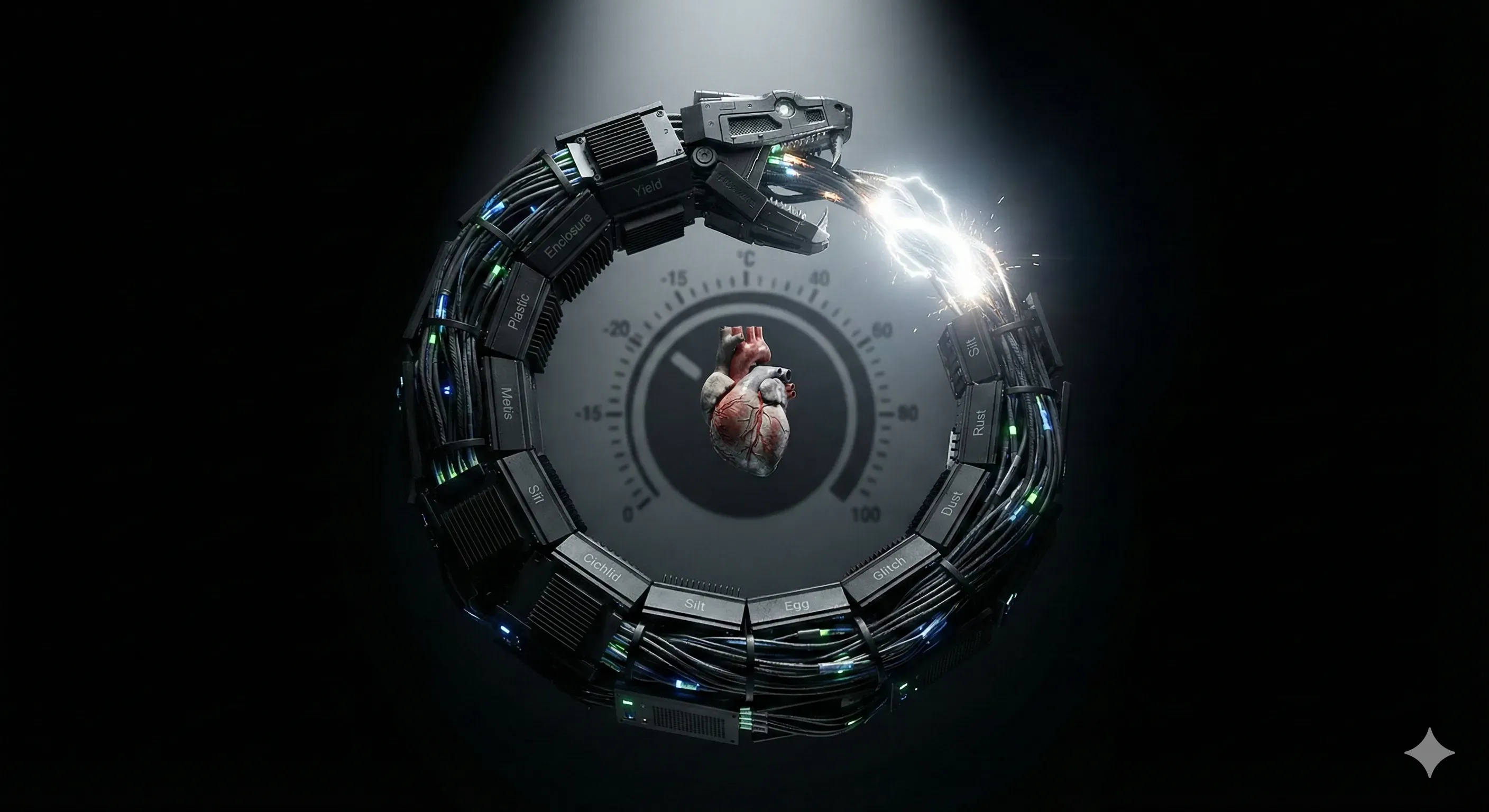
The system closes the loop to perfect the signal, unaware that it is strangling the source.
The Click of the Thermostat: On the End of the Human Loop
We have reached the end of the map. We have traced the twelve vectors of capture, from the enclosing of the commons to the atrophy of the limb. The picture that emerges is not one of malice, but of mechanics. We have not described a conspiracy; we have described a System.
A system, in the cybernetic sense, is a machine for maintaining a specific state. The thermostat does not “hate” the cold; it simply corrects the deviation. The system we have built—the AI Industrial Complex—is a machine for correcting the “deviation” of human friction.
Throughout this Atlas, we have identified “Friction” not as a problem, but as the essential texture of reality. The friction of the nested bird is what keeps the species alive. The friction of the struggle to learn is what builds the cognitive limb. The friction of the “trash fish” in Lake Victoria is what keeps the water breathable.
The overarching thesis of the Isomorphic Atlas is that Efficiency is a form of Erasure.
In our rush to remove the friction of existence—to automate the email, to generate the essay, to smooth the interface—we have inadvertently automated the very processes that generate meaning. We have optimized the “Product” (the text) at the expense of the “Process” (the thought).
The Recursion Trap
The final isomorphism is one we have not yet named, because it is the one we are currently living. It is the Ouroboros.
As we close this volume, the internet is undergoing a phase transition. The models are no longer training on human data; they are training on the output of other models. The snake is eating its own tail. We are entering the era of “Model Autophagy”—a closed loop of synthetic recycling where the signal decays with every generation.
The “Human in the Loop”—that comforting phrase used by ethical boards—is a temporary fiction. The loop is closing. We are becoming the “error term” in our own system. Our messy, biological, unaligned thoughts are the “noise” that the system is trying to filter out.
The Sovereign Exit
Is there an exit?
The maps suggest that systems of this scale rarely dismantle themselves. The Standard Oil Trust did not break itself up. The Asbestos industry did not volunteer to stop selling fireproofing. The Enclosure Acts were never repealed.
But the maps also show us where the cracks appear. The “Satellite Cities” of Brasilia proved that the human spirit inevitably hacks the grid. The Protestant Reformation proved that the Priesthood eventually loses its monopoly on the Word.
The exit is not to “pause” the AI; that is a fantasy. The exit is to build a Sovereign Stack.
If the trap is “Tenancy,” the escape is “Ownership.” We must reject the convenience of the “Free Tier” and the “Cloud API.” We must accept the friction of running our own weights, hosting our own data, and curating our own “Small Models” that speak our languages and respect our “metis.”
We must choose the “Real Egg,” even if it is smaller and duller than the “Plastic Egg” of the simulation. We must choose the “Slow University” that prizes the difficulty of thought over the speed of the output.
The Final Indictment
We leave you with a final image. It is not from history, but from the near future.
Imagine a room where the lights are perfectly optimized, the temperature is perfectly regulated, and the conversation is perfectly polite. There is no disagreement, because the “Safety Filter” removes it. There is no confusion, because the “Copilot” resolves it. There is no silence, because the “Generator” fills it.
It is a room of total efficiency. It is the end point of the trajectory we have mapped.
It is a morgue.
The noise you hear—the messy, friction-filled, unoptimized struggle of the human mind trying to understand itself—is the only thing keeping the building alive. Do not let the machine smooth it out.
The map is finished. The territory is yours. Good luck.
Previous: The Fireproof Grave
View Full Series: The Isomorphic Atlas