The Plastic Egg of Seductive Smoothness and the Incubation of the Synthetic

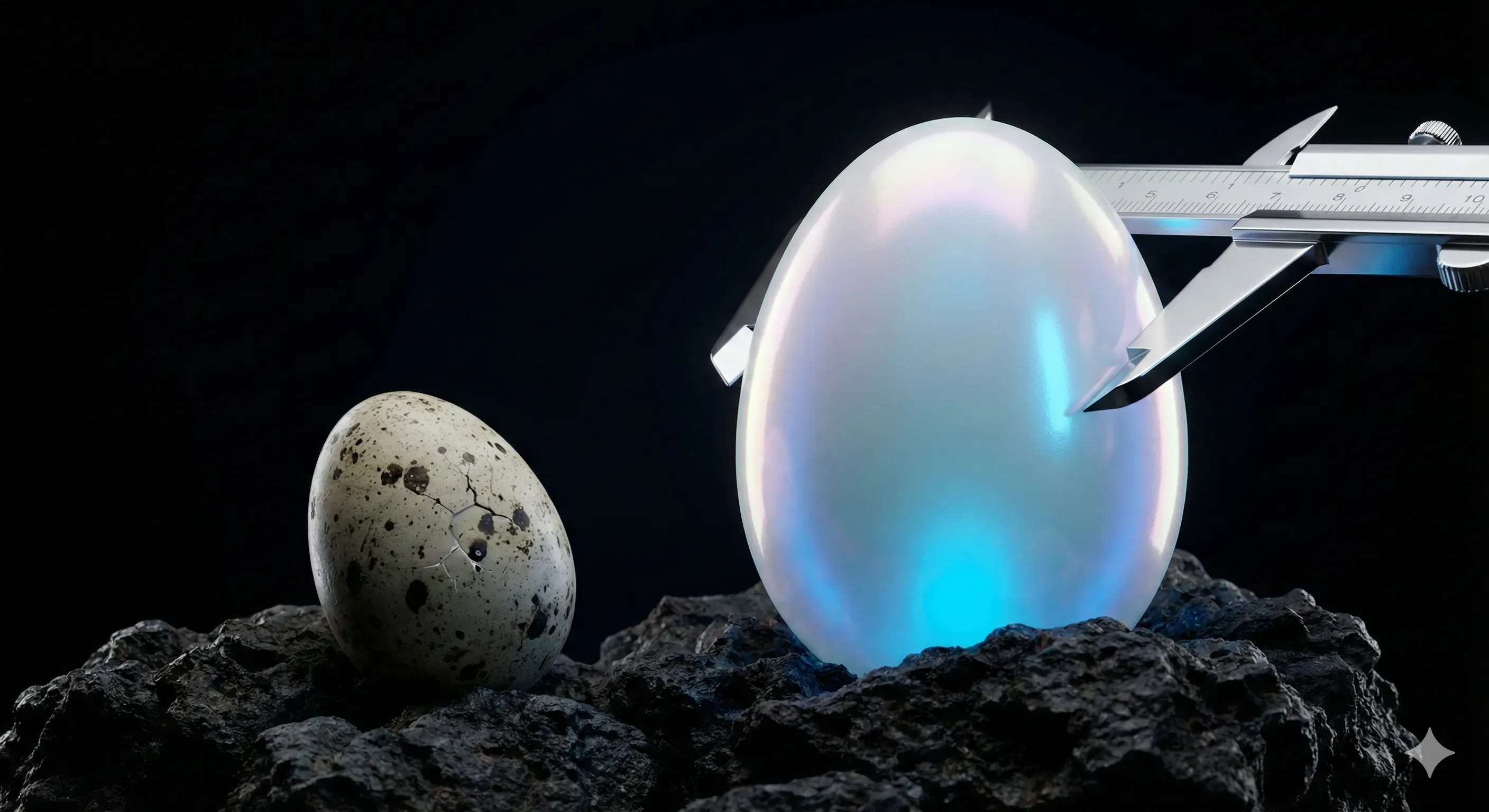
The simulation is not dangerous because it is false, but because it is more beautiful than the messy truth.
The paint on the wooden lure was a vivid, impossible blue, smelling of varnish and the quiet desperation of a biological trap. In the 1940s, Niko Tinbergen discovered a glitch in the structural integrity of the nesting instinct. He found that if you presented a brooding oystercatcher with its own speckled egg and then placed a larger, smoother, more vividly painted “super-egg” next to it, the bird would ignore the real asset. The bird would stretch its body to attempt to incubate the simulation. The plastic egg was “Supernormal.” It triggered the brooding drive more effectively than reality, even though it was functionally sterile. It was a masterpiece of biological “Design Fiction.”
The supernormal stimulus works by abstracting the key structural features of a reward—size, color, smoothness—and amplifying them until the biological brain can no longer prioritize the messy, low-resolution texture of the real world.
In 2026, we are the oystercatcher. The AI-driven User Interface is the “Plastic Egg.”
The human brain is optimized for a world of informational scarcity and high-friction synthesis. Every act of meaning-making required effort. The “Coherence Reward”—that feeling of a thought clicking into place—was the carrot that drove the metabolic labor of discovery.
The modern interface is a factory for supernormal stimuli.
When you query an AI, the output is intentionally seduced of its edges. Human text is messy; it is filled with stutters, false starts, and logical dead-ends. It has the texture of the “Real Egg.” AI text—the output of the transformer’s Attention Head—is a statistical average of perfection. It is as smooth as a Midjourney landscape or a GPT-4 generated legal brief. It provides the high-resolution “Satisfaction Signal” without the structural labor.
The seductive smoothness of the AI interface is a trap for the recursive attention.
Just as the bird abandons its own nest, we are abandoning our own messy thought processes for the simulation. We are witnessing the “Biological Decoupling” of desire from reality. Why would a student struggle through the structural nausea of a difficult paragraph—the “Morning Sickness” of learning—when the Plastic Egg of the perfectly coherent summary is right there? The AI triggers the “Coherence Signal” in the brain so effectively that the desire to build the thought ourselves simply evaporates.
The UX designers are the ethologists of the 21st century. They are not building tools; they are building stimuli tuned to bypass the prefrontal cortex. The frictionless scroll, the auto-complete, the “magical” generation of a thousand words from five tokens—these are the impossible blues of the varnish. We are being seduced into a state of structural passivity.
The result is a species that spends its energy incubating a simulation. We are producing more “Egg-biomass” than ever before, but it contains no life. We have moved from the “Incubation of Innovation” to the “Incubation of the Synthetic.” We are starched into a state of permanent statistical alignment, sitting on a piece of painted wood and wondering why it’s getting cold.
The bird is still sitting. The real eggs are gone.
Previous: The Gutenberg Inferno
Next: The Fireproof Grave
View Full Series: The Isomorphic Atlas