Non-Biodegradable Discourse and the Micro-Plastics of the Mind

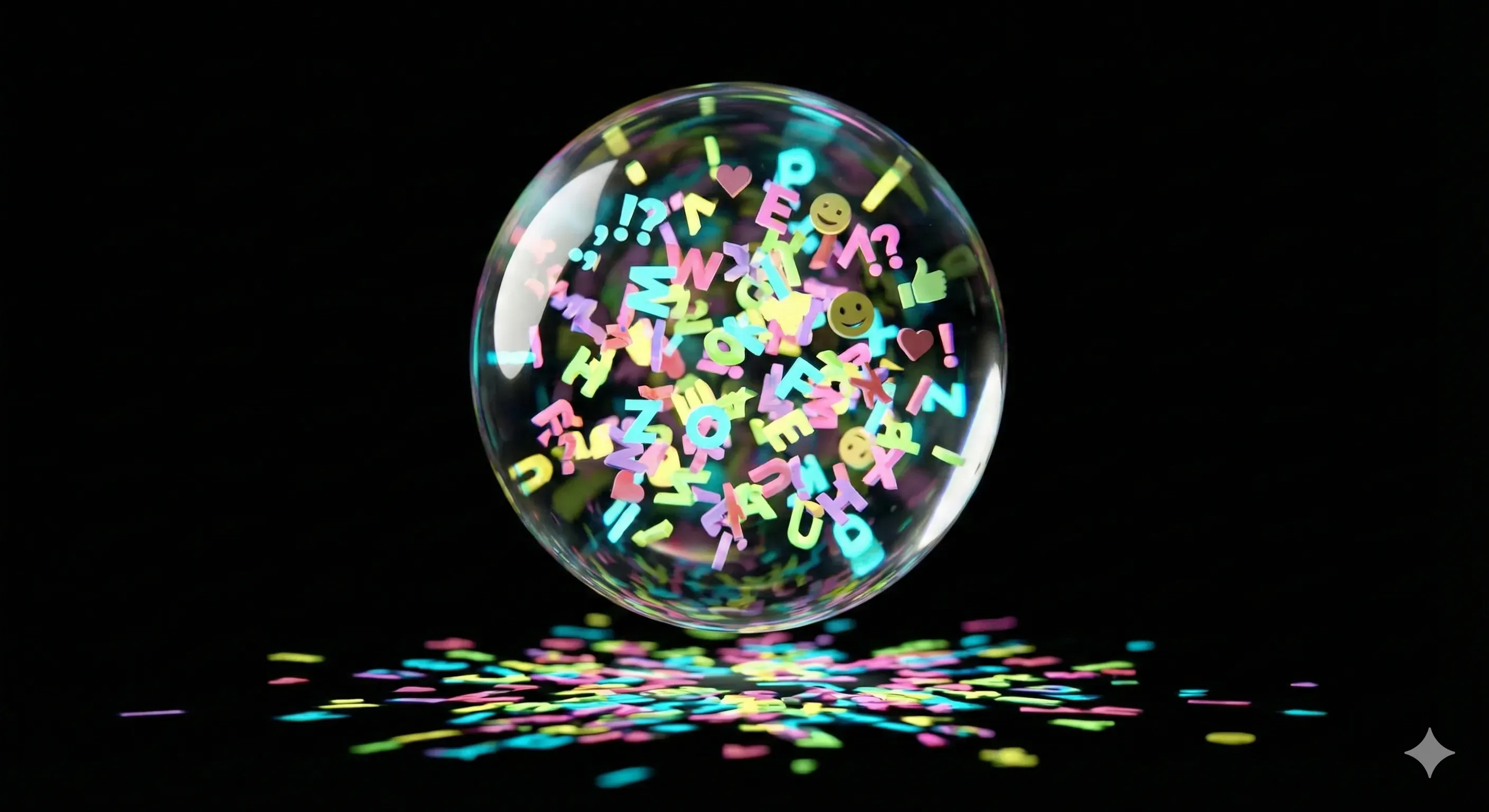
We are filling the oceans of discourse with a plastic that mimics the shape of meaning but lacks the grace of decay.
The material was born in a pressurized kettle in Yonkers, smelling of formaldehyde and the future. In 1907, Leo Baekeland synthesized Bakelite, the world’s first fully synthetic plastic. It was heralded as the “material of a thousand uses”—cheap, durable, and infinitely moldable. It was the ultimate triumph of the laboratory over the limitations of nature. For the first time, humanity wasn’t limited by the slow growth of trees or the finite supply of ivory. We could mold the world to our desires at scale.
But plastic had a hidden property: it was non-biodegradable. The very durability that made it a miracle made it a systemic toxin. The natural world—the bacteria, the fungi, the slow rot of the seasons—had no program for breaking down a synthetic polymer. Plastic didn’t go away; it merely fragmented. Today, it is in the Arctic ice, the Mariana Trench, and your blood. We are ingesting the “miracle” in every breath. The planet cannot metabolize the convenience.
In 2026, we are witnessing the birth of Digital Plastic. We call it “Synthetic Media.”
The output of LLMs and Diffusion models is the Bakelite of human culture. It is infinitely moldable. It allows us to produce “meaning” at a scale that was previously impossible. We can now generate a thousand marketing scripts, a hundred blog posts, and a dozen “news” articles in the time it takes to brew a cup of coffee. This is the ultimate efficiency of the synthetic lab.
But like Bakelite, synthetic media does not rot.
Human culture has always had a metabolic filter for truth: decay. The “Link Rot” of the early web was a kind of mercy—a natural process where bad ideas, poorly researched articles, and boring conversations were allowed to decompose. They weren’t cited; they weren’t shared; they disappeared into the soil of the past. This acted as a biological stabilizer for human attention.
The “AI Rot” is different. It is the preservation of the mediocre. A generative model never tires, and its output—unlike a human conversation—does not age. It persists in the archives of the internet with the same high-resolution persistence as the day it was created. It clogs the oceans of discourse. We are witnessing the “Great Clogging.”
Look at the “Micro-Plastics of the Mind.” Just as physical micro-plastics have entered the food chain, “Micro-AI” is entering the informational chain. These are the subtle, low-level errors—the statistical drifts and the slightly-off syntax—that are being woven into every search query and every automated customer service interaction. We are ingesting these micro-plastics in every digital interaction.
The problem is not the “Great Deepfake.” The problem is the “Subtle Error” that no one can find. When a search engine provides a synthetic summary, it is injecting informational micro-plastics into your decision-making loop. When a student uses a model to “polish” an essay, they are weaving non-biodegradable statistical averages into the specific “metis” of their own thought.
We are experiencing the informational equivalent of an impaction—a blockage so dense that the system can no longer move. We are swimming in a sea of Bakelite, wondering why everything feels so smooth, so predictable, and so increasingly toxic.
We can’t ban plastic, and we won’t ban AI. But we are learning that the price of “infinite moldability” is a world that can no longer break down its own mistakes. The archive is full. The stream is jammed. How do we find the signal in the silt?
Previous: The Trophic Collapse
Next: The Vertical Pipe
View Full Series: The Isomorphic Atlas