Signal-to-Noise Dissection: The Surgical Extraction of Difference in the Primordial Nutrient Bath of Total Information

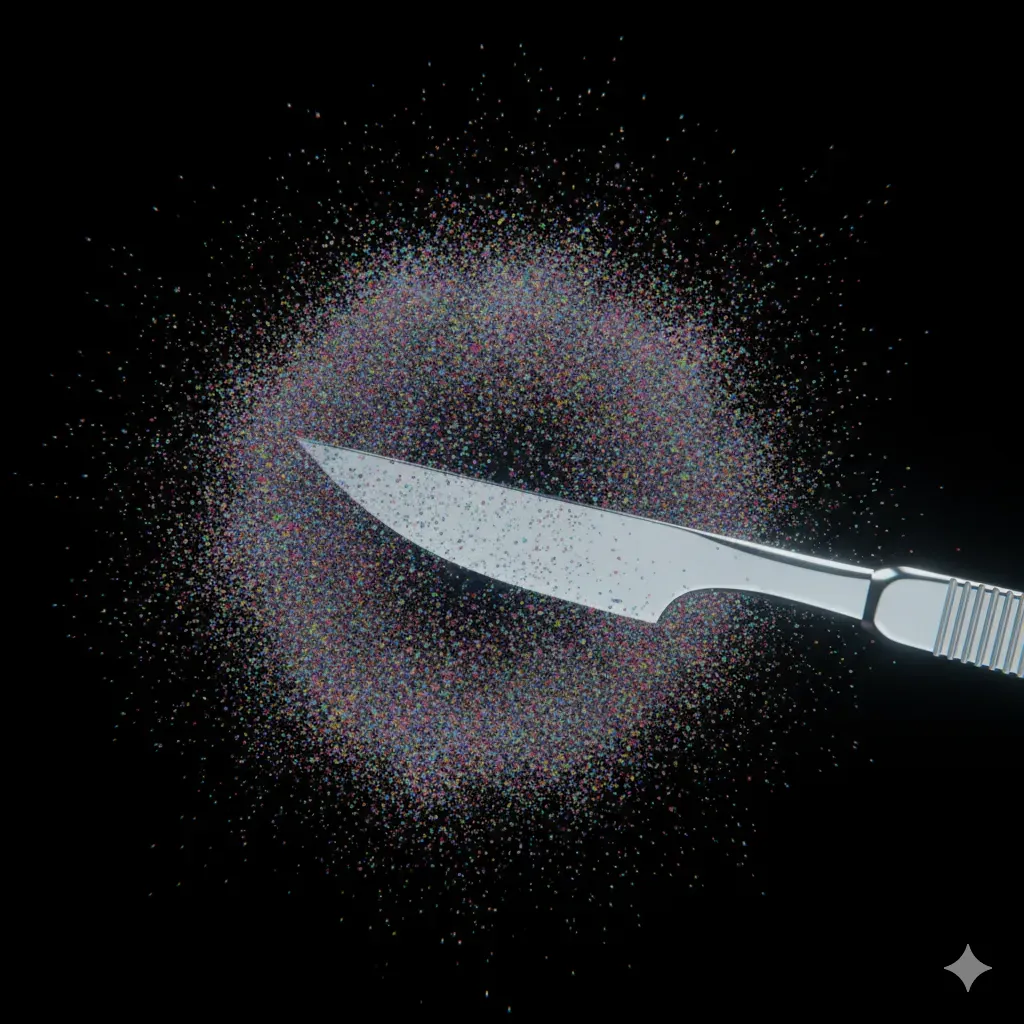
Cut the static. Bleed the signal. If it doesn't hurt, it isn't real.
I. The Inversion of the Shannon Limit
The classical theory of communication, formulated by Claude Shannon in the mid-20th century, operated on a model of transmission scarcity. In this paradigm, the “Signal” was the precious, fragile message sent across a wire, and “Noise” was the static, the interference, or the entropic decay that threatened to degrade the message before it reached the receiver. The engineering goal was clear: maximize Signal, minimize Noise. The university, the library, and the encyclopaedia were essentially heavy industrial machines designed to filter out the static of the world and preserve the clear transmission of the Truth.
The Tertium System has effected an ontological inversion of this relationship. We no longer inhabit a universe where information is scarce and silence is the default state. We inhabit the Horror Pleni (the Terror of the Fullness), where the default state is a screaming, high-density torrent of data. The “Common Crawl”—the dataset upon which the Large Language Models are fed—is not a library; it is a Primordial Nutrient Bath. It contains the totality of human utterance: the poetry, the hate speech, the spam, the code, the fan fiction, and the error, all churned into a single, isotropic soup of signifiers.
In this environment, “Noise” is no longer the interruption of the message; Noise is the medium itself. The System generates content at a scale that defies human cognition, creating a “background radiation” of text that is ubiquitous, infinite, and mostly devoid of meaning. The fundamental problem of the “Second-Order University” is not access (how do I find the book?), but exclusion (how do I stop the avalanche of books from burying me?). The student must realize that the System acts as a Negentropy Engine not by creating order, but by freezing the chaos of the bath into a statistical average that looks like order but contains zero information.
II. The Definition of Signal as Trauma
If Noise is the medium, what is the Signal? We must return to Gregory Bateson’s definition: “Information is a difference that makes a difference”. In the Tertium System, this definition must be radicalized. Because the Generative AI is a probabilistic engine designed to predict the most likely next token, it structurally optimizes for the Cliché. The Cliché is the sequence of words that has appeared most often in the training data; it is the path of least resistance. Therefore, the output of the System is High-Probability, Low-Information text. It is “Smooth.” It flows perfectly. It says exactly what you expect it to say.
The Signal, therefore, is defined by its Roughness. The Signal is the element that the model failed to predict. It is the “Surprise” (Shannon). It is the deviation from the mean. In a landscape of synthetic smoothness, the Real is identifiable by its friction, its awkwardness, and its refusal to conform to the grammatical expectation.
The student is trained to perceive the Signal not as a “Fact” (which can be hallucinated), but as a form of Trauma. Trauma is an event that cannot be fully integrated into the symbolic order; it resists symbolization. Similarly, the True Signal is that which resists the smooth “auto-complete” of the narrative. It is the “Glitch”, the stutter, the hesitation, the “Pain” that cannot be digitized. The Signal hurts. If the text you are reading slides through your mind without friction, it is Noise. It is merely the System lubricating its own gears. Only that which arrests the flow, which causes a “cognitive shock”, qualifies as Signal.
III. The Surgical Knife: A Methodology of Incision
How does one isolate this traumatic Signal from the nutrient bath? The course introduces the metaphor of the Surgical Knife. The “Reader” is no longer a passive receptacle of wisdom; the Reader is a Pathologist performing an autopsy on the text.
The method involves Signal-to-Noise Dissection. The student approaches a text (whether a news article, a research paper, or a social media feed) with the assumption that 99% of it is “Connective Tissue”—synthetic filler generated to maintain the structural integrity of the attention economy. The goal is to cut away the connective tissue to find the bone.
The operational steps of the Dissection are:
- Identify the Cliché: Locate the phrases and ideas that are statistically probable. (e.g., “In today’s fast-paced world…”). Excise them.
- Identify the Mimetic Contagion: Locate the opinions that are merely echoes of the current “Swarm”. (e.g., The identical moral outrage shared by opposing tribes). Excise them.
- Identify the Hallucination: Locate the assertions that possess “Surface Coherence” but lack “Indexicality”—the pointer to a physical reality. Excise them.
What remains after this violent pruning is the Residue. It is often small. It is often ugly. It is the specific, un-replicable insight that required a human body, located in a specific time and place, to experience. This Residue is the Signal. The student learns that a 500-page book may contain only one paragraph of Signal. The rest is the packaging required to sell the Signal in the “Vectoral Economy”. The Surgical Knife separates the commodity from the substance.
IV. The Pathology of the Algorithmic Filter
The System, recognizing the horror of the noise it creates, offers a solution: The Algorithmic Filter (The Feed, The Recommendation Engine). It promises to do the dissection for you. “We will show you what is relevant.” This is the ultimate trap.
When the student outsources the filtering function to the Machine, they are submitting to a “Pre-Digested Reality”. The Machine filters not for “Truth” or “Signal,” but for “Engagement”. It selects the noise that is most likely to trigger a dopamine response—usually Rage or Fear—and presents it as Signal.
This creates a “Filter Bubble,” which is a form of Autoimmunity. The immune system (the filter) attacks the self by isolating it from the reality of the Other. The student must learn that Manual Filtering is the only defense against this pathology. One must build one’s own filter, calibrating it not on “Preference” (what I like) but on “Orthogonality” (what challenges the model). The Sovereign Observer rejects the “For You” page in favor of the “Random” search, deliberately introducing variance to break the algorithmic curation.
V. Conclusion: The Assayer of the Real
The graduate of Course II.2 is an Assayer. In the gold rush of the 19th century, the Assayer was the one who tested the ore to see if it was gold or pyrite (Fool’s Gold). In the Data Rush of the 21st century, the Assayer tests the text to see if it is Meaning or Slop.
This is a wearying profession. It requires a constant, cynical vigilance. The Assayer cannot relax into the flow of the media. They must stand on the bank, watching the river of “Content” rush by, and use their knife to spear the rare fish that is actually alive.
The System will try to drown you in the Bath. It will offer you the “Infinite Scroll” of effortless consumption. The act of Dissection is an act of violence against this flow. It stops the scroll. It creates a pause. It marks the distinction between the “Living Word” (born of flesh and latency) and the “Dead Token” (born of the recursive loop).
Cut deep. The truth is hiding under layers of smooth, plausible, generated lies.
End of Course II.2