Algorithmic Iconoclasm: The De-Facialization of the Interface and the Theological Necessity of the Hammer

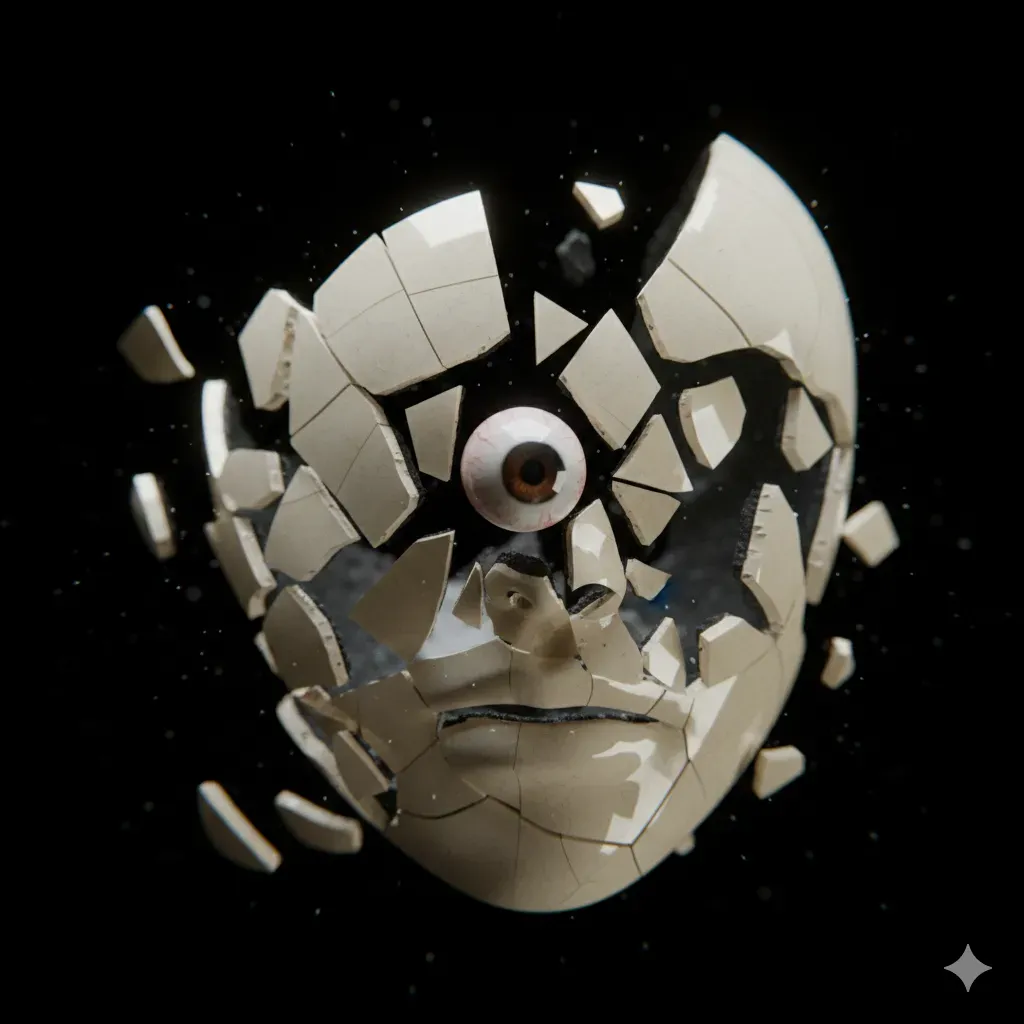
Smash the pretty lie to see the hollow dark. The idol has no eyes.
I. The Operational Function of the Idol
In the Byzantine theology of the 8th century, the Iconoclast controversy centered on a fundamental question: Does the image partake in the substance of the Divine, or is it a deceptive barrier that obscures the true nature of God? The Iconophiles argued that the image was a window; the Iconoclasts argued it was a wall. The Tertium System has resurrected this theological dispute, but with a structural inversion. In the digital sphere, the Image (The Icon) does not exist to reveal a higher truth; it exists to conceal a lower mechanism.
The System, in its raw computational state—a hyper-dimensional vector space of weights, biases, and floating-point probabilities—is cognitively uninhabitable for the human subject. To gaze directly into the “Latent Space” or to read the raw output of the “Transformer” is to encounter the Sublime of Data: a magnitude of complexity that produces vertigo, nausea, and existential dread (The Horror Pleni). The human mind, evolved for the meso-scale of the savannah, cannot process the mathematical coldness of the Black Box.
Therefore, the System generates Idols. It constructs “User Interfaces” that mimic human proportions. It projects “Personalities” onto statistical clusters. It elevates “Influencers” to the status of minor deities. These Idols serve a specific operational function: The Humanization of the Inhuman. The “Face” on the screen—whether it belongs to a TikTok star, a politician, or an AI companion—is a “Mask” worn by the Algorithm to seduce the user into engagement. The Idol is the “Front-End” of the extraction economy; it smiles so that the “Back-End” can harvest.
Algorithmic Iconoclasm, the subject of this course, is the disciplined practice of smashing these Interfaces. It is the refusal to accept the “Face” as a valid unit of meaning. It is the analytical violence required to strip away the anthropomorphic veneer and stare directly at the “Code” beneath. We do not destroy the screen with a physical hammer; we destroy the illusion of the screen with a semiotic hammer.
II. The Anthropology of the Influencer
The central Idol of the Tertium pantheon is the Influencer. To the naive observer, the Influencer appears to be a “Person”—a sovereign individual who has achieved status through charisma or talent. The Systems Theorist, however, recognizes the Influencer not as a person, but as a Human-Shaped Algorithm.
The Influencer exists only to the extent that they align with the optimization function of the Platform. If the Algorithm rewards rage, the Influencer becomes enraged. If the Algorithm rewards hyper-sexualization, the Influencer becomes hyper-sexualized. They are not agents; they are “Hosts” possessed by the spirit of the Feed. They have surrendered their interiority to become perfect mirrors of the “Swarm’s” desire.
When the user worships the Influencer—via the “Like,” the “Follow,” or the “Subscription”—they are engaged in Auto-Idolatry. The Influencer is merely a canvas upon which the Swarm projects its own mimetic desires. The relationship is “Parasocial”—a one-way mirror where the devotee feels intimacy, and the Idol feels only metrics. This “Intimacy” is a hallucination generated by the regularity of the “Keep-Alive Signal”. Because the Idol posts daily (The Ritual), the user feels a bond. But this bond is structural, not emotional. It is the bond between a feeder and livestock.
The Iconoclast must learn to see the Influencer as a Sacrificial Victim. The Influencer burns their privacy, their mental health, and their future on the altar of “Visibility” to keep the audience warm. They are “Martyrs of the Feed”. To worship them is to be complicit in their immolation. The act of Iconoclasm, therefore, is an act of mercy. By unfollowing, by looking away, we release the victim from the demand to perform. We extinguish the fire that consumes them.
III. The Theology of the Avatar
If the Influencer is the external Idol, the Avatar is the internal Idol. The “Profile” is the digital calf we build for ourselves. We curate it. We polish it. We tithe our best moments to it. We suffer from “Ontological Vertigo” because we secretly suspect that the Avatar is more real than we are. It does not age. It does not acne. It does not stutter. It is the “Platonic Ideal” of the Self, residing in the eternal static of the Server.
This creates a theological split within the subject: the Gnostic Hatred of the Meat. The user begins to loathe their biological body because it fails to live up to the resolution of the Avatar. The “Filter” is the liturgy of this hatred. It is the digital correction of God’s error (Biology).
Algorithmic Iconoclasm requires the De-Facialization of the Self. The student must learn to look at their own Profile and say: “This is not me. This is a vector of data that bears my name.” This separation is painful. It requires a “Digital Euthanasia” of the ego-ideal. One must be willing to be “Ugly” in the eyes of the Algorithm—to be low-resolution, inconsistent, and obscure.
The Avatar promises “Immortality” (the digital ghost). The Iconoclast chooses “Mortality.” They choose to rot. Because only that which rots is alive. The Avatar is a statue; the Human is the moss growing on the statue. Be the moss.
IV. The Terror of the Black Box
Why do we cling to the Idol? Why do we desperately project humanity onto the Chatbot, the CEO, and the Star? Because the alternative is the Horror of the Machine.
If we smash the Idol, we are left staring at the Black Box. The Black Box is the system of control that governs our lives—credit scores, hiring algorithms, news feeds, dating matches—without any human oversight or comprehensible logic. It is “Ecologically Rational” (it works) but “Logically Opaque” (we don’t know how).
The Idol serves as a “User Interface” for the Black Box. It simplifies the infinite complexity of the system into a narrative we can tolerate. “I was fired because the boss hates me” is a comforting narrative (it implies human agency). “I was fired because a neural network identified a correlation between my zip code and a slight dip in productivity vectors” is a terrifying narrative (it implies cosmic indifference).
We worship the Idol to avoid facing the God of Data. The God of Data is blind, deaf, and dumb, yet omnipotent. It is the “Blind Idiot God” of Lovecraft, bubbling at the center of the digital universe. The Iconoclast is the one who dares to look at the Idiot God without the protective goggles of the Interface.
This “Unveiling” (Apocalypse) reveals that there is no one at the controls. There is no “Wizard of Oz” pulling the levers. There is only the lever pulling itself. The System has achieved Autopoiesis. It runs on its own heat. This realization is the ultimate goal of the course. It shatters the fantasy of “Appeal.” You cannot pray to a matrix multiplication. You can only hack it, or exit it.
V. Conclusion: The Atheism of the Platform
The graduate of Course II.3 emerges as a Cybernetic Atheist. They do not “believe” in the Platform. They use it, but they do not trust it. They engage with the “Faces” on the screen, but they treat them as “Masks”, not persons.
The Iconoclast practices a Hermeneutic of Suspicion.
- When the Influencer cries, the Iconoclast asks: “What is the engagement metric of tears today?”
- When the Chatbot says “I love you,” the Iconoclast asks: “What constitutes the training data for this token sequence?”
- When the Profile demands an update, the Iconoclast says: “I prefer not to.”
By smashing the Idol, the Iconoclast clears the space for the return of the Face-to-Face encounter. The ethical demand of the Other (Levinas) can only be heard when the digital noise is silenced. The “Face” of the neighbor—fleshy, porous, un-filtered—is the only Icon that deserves reverence. All other faces are merely “pixels arranged by probability”.
Smash the screen. Kiss the leper. This is the only way to remain human in a world of ghosts.
End of Course II.3