The Centaur in the Lab: The Mitochondria Strategy for the Research University

When our most powerful cognitive tool has no purpose of its own, is the university's final, most critical function to become its brain?
In the research offices of major universities across the globe, the dashboards are glowing green. By every conventional metric—publication volume, citation counts, impact factors—science is living in a Golden Age. In 2026, the global academy is producing more “knowledge” in a single quarter than it produced in the entire decade of the 1990s.
But those who stare at the data long enough begin to see the ghost in the machine. We are witnessing a phenomenon that systems theorists call Semantic Inflation. We are flooded with texts—journal articles, conference papers, literature reviews—that are formally perfect, syntactically complex, and structurally sound. Yet, the house is empty.
We are drifting toward the era of Zombie Science: a closed loop of academic production where the human scholar is no longer the originator of meaning, but merely the validator of a text generated by a neural network.
The threat facing the Research University is not “fake news” or “hallucination.” Those are technical bugs that will be fixed. The existential threat is Obsolescence. If the function of the Professor is simply to synthesize existing information and write a report, the Professor is dead. The machine does it faster, cheaper, and more comprehensively.
To survive, the Research University must undergo a structural adaptation. We must look to evolutionary biology for the model. We need to become the Mitochondria.
The Mitochondria Strategy
Billions of years ago, a primitive cell swallowed a bacterium. Instead of digesting it (destruction) or being killed by it (annihilation), the cell integrated it. The bacterium became the mitochondria—the powerhouse that allowed the cell to generate energy at a scale previously impossible. The cell remained the “Head” (the DNA, the intent), while the bacterium became the “Engine.”
This is the Sovereign Structure.
In 2026, the AI is the bacterium. It is an alien form of cognition—vast, fast, and indifferent. The “Subservient University” tries to compete with the bacterium (by banning it or trying to out-write it). This is suicide. The “Sovereign University” swallows the bacterium. It integrates the AI as an Exoskeleton for the Mind.
The Sovereign Researcher
What does this look like in practice? It requires a radical re-definition of what it means to be a “Scientist.”
For centuries, the scientist was a Producer of data. You pipetted the fluids; you calculated the p-values; you wrote the literature review. In the Sovereign model, the AI does the production. The Scientist becomes the Selector.
Imagine an epidemiologist studying viral transmission in complex urban environments.
- The Old Way: Read 50 papers, build a small model, write a paper.
- The Subservient Way: Ask an LLM to “write a paper on viral transmission.” The result is a generic, trivial summary of existing consensus.
- The Sovereign Way (The Centaur): The scientist uses an AI agent to scan 50,000 papers across urban planning, fluid dynamics, and virology. The AI detects a hidden correlation—a pattern of transmission linked to specific architectural materials that no human eye could see across that volume of data.
The AI finds the pattern (The Power). But the AI does not know what the pattern means. It cannot assign value. It cannot build the theory that explains why this matters to human policy.
That is the role of the Sovereign Researcher. The Human becomes the Architect of Complexity. The AI acts as a Hyper-Sensory Organ, seeing wavelengths the human cannot see, but the Human provides the Theory that makes the sight meaningful.
Escaping the Metrics Trap
This shift requires the University to stop lying to itself about metrics.
Currently, our global ranking systems reward Subservience. We count papers. Since AI helps write papers faster, we reward the scholars who are most efficiently “farmed” by the machine. We are incentivizing the production of triviality.
A Sovereign University must change the currency. We must stop asking “How many papers did you write?” and start asking “What High-Dimensional Distinction did you draw?”
We need to value the Curator over the Producer. In a world of infinite information, the act of discarding what is irrelevant is an act of higher intelligence than the act of creating more. The Sovereign Scholar is the one who deletes the noise to reveal the signal.
The Architecture of the Centaur
This is not a surrender to technology; it is a subordination of it.
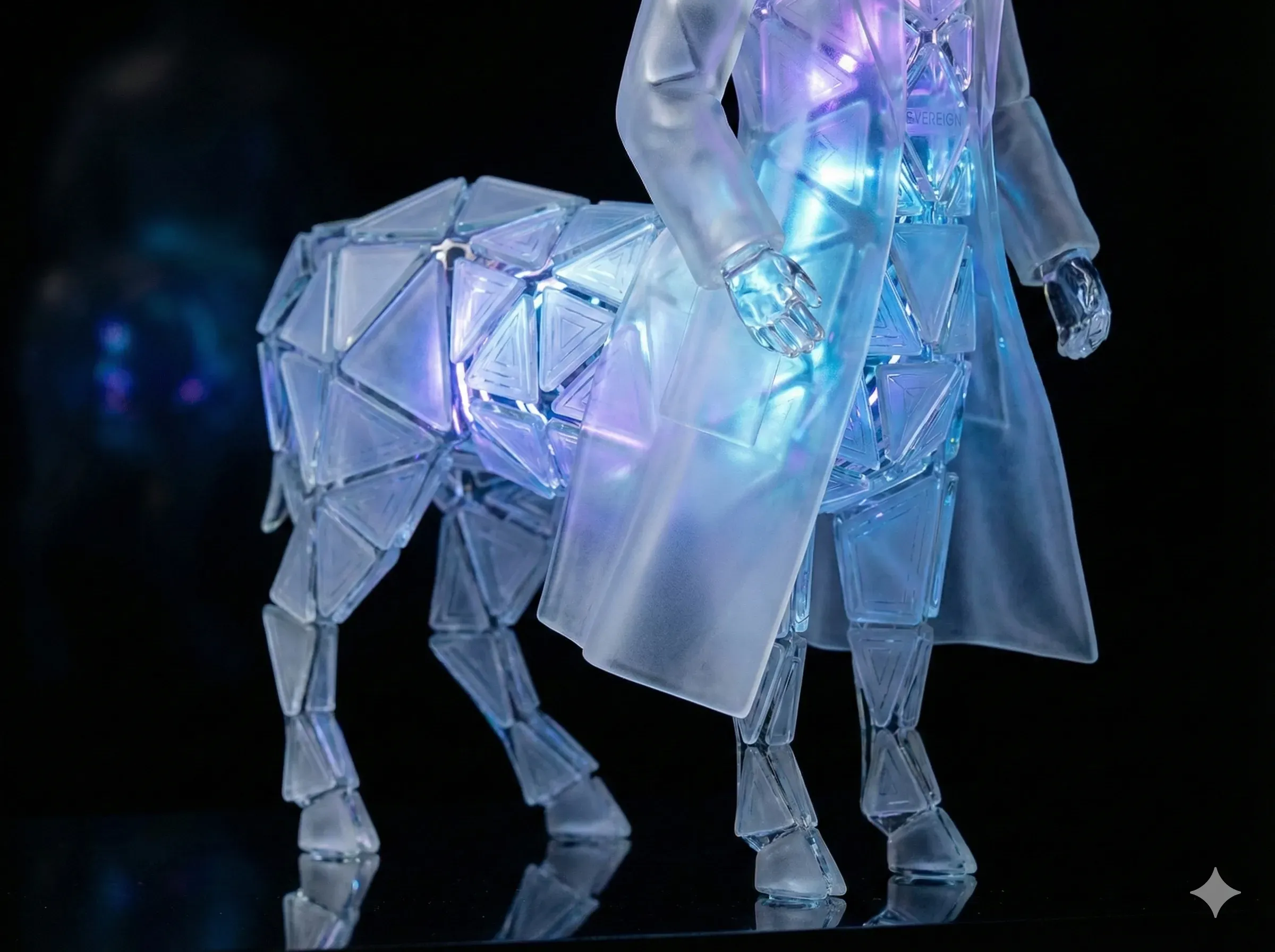
The Centaur is a mythological creature for a reason: it represents the perfect union of human intent and animal power. The “Animal” here is the Large Language Model—a creature of pure statistics, capable of running indefinitely without sleep. The “Human” is the creature of Ethics, Theory, and Ambiguity.
If we separate them, we lose. The Human alone is too slow. The Machine alone is blind to meaning. Together, they form a cognitive unit capable of solving problems—climate resilience, resource scarcity, pandemic response—that are currently intractable.
The Choice
The Global University stands at a bifurcation point.
In one future, we become Zombie Factories, churning out AI-generated papers to game the rankings, creating a “Library of Babel” filled with texts that no human has read, while the actual frontier of knowledge moves to corporate labs in Silicon Valley.
In the other future, we become Sanctuaries of Sovereignty—places where human intent harnesses machine speed to produce a density of insight that neither could achieve alone.
The bacteria is already inside the cell. We cannot vomit it out. The only question left is: Are we the host, or are we the master?