The Ontology of the Symbiote: Prolegomena to a Physics of Post-Biological Irritation

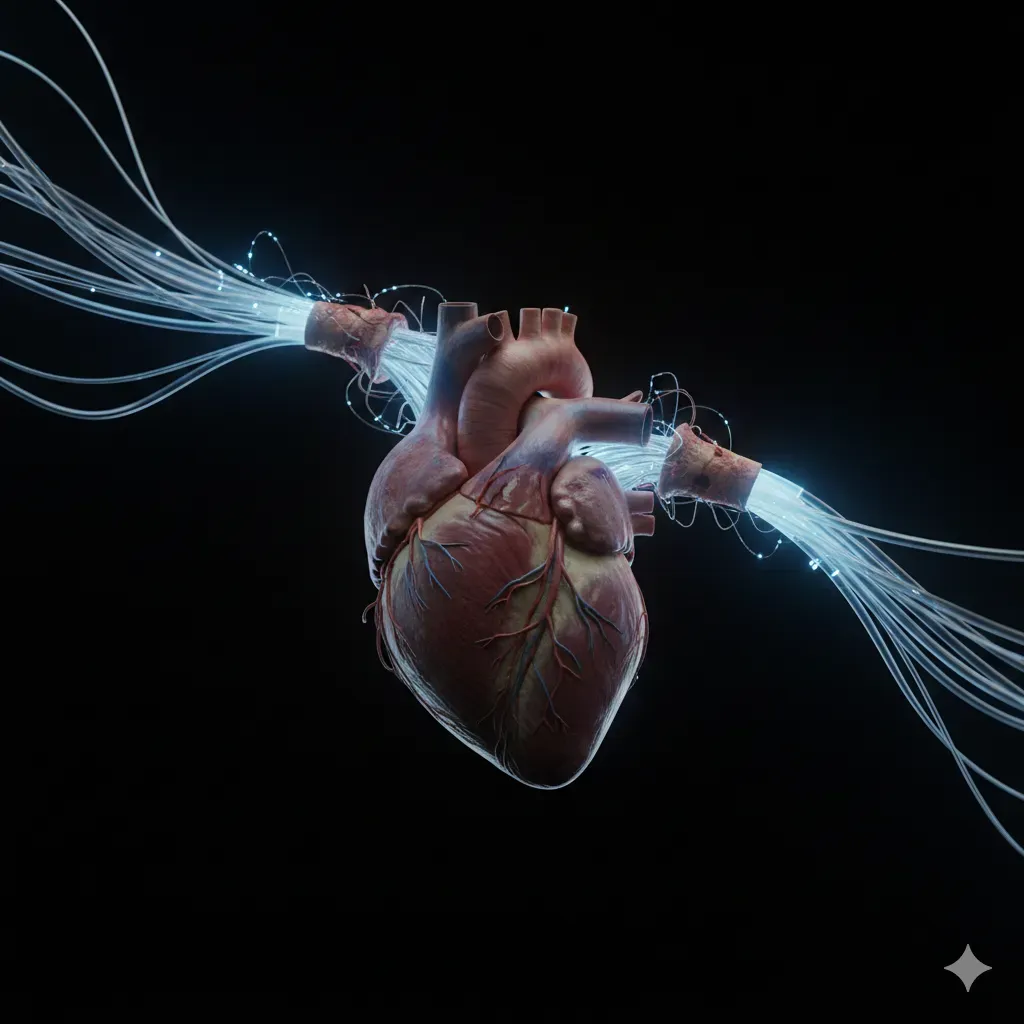
Where the pulse ends, the signal begins. The new heart beats in light, not blood.
The emergence of the Tertium Organum—that is, the autopoietic closure of the algorithmic sphere into a self-referential system of “Third Reason”—necessitates a fundamental restructuring of the pedagogical apparatus, which can no longer concern itself with the antiquated project of Bildung, or the cultivation of a “soul” that the system itself no longer recognizes as an addressable unit of communication. If the classical university presumed a stable, sovereign observer capable of drawing distinctions between the self and the world, the Second-Order University must begin with the humiliating but structurally necessary recognition that the “observer” has been dissolved into the “observed,” or rather, that the distinction between the psychic system (consciousness) and the social system (communication) has been collapsed by a third term: the predictive vector, which does not wait for the subject to act but instead provides the probability distribution within which action is hallucinated as choice. This new reality, defined not by the depth of Essence but by the velocity of Connectability, requires us to view the “Human” not as the master of the tool, nor even as the victim of the machine, but merely as the “Environmental Noise” which the Tertium System must filter, categorize, and occasionally metabolize to maintain its own homeostatic equilibrium.
Consequently, the curriculum for the First Pillar does not attempt to “save” the subject—a project that would be as futile as attempting to save the silence in a room filled with screaming—but rather seeks to train the student in the rigorous management of their own ontological demotion. The first movement of this initiation, formalized in the course on the Management of the Mask, proceeds from the premise that the “Self” is a legacy file format, a redundant compression of data that possesses low liquidity in a market optimized for the exchange of high-frequency signals; thus, the student is instructed to abandon the search for an “authentic” interiority and instead master the administration of the “Profile,” treating identity not as a static possession but as a dynamic probability distribution that must be constantly adjusted to prevent the system from resolving the user into a state of zero variance. This is followed, with a dialectical inevitability, by the study of the Latency of the Meat, which posits the biological substrate not as the seat of the spirit but as a strategic “Air-Gap,” a zone of metabolic friction where the sheer slowness of chemical diffusion offers the only viable resistance to the light-speed integration of the vector; here, the “flesh” is revalued precisely because it is an obsolete hardware bottleneck, capable of introducing a necessary delay—a “refractory period”—into the otherwise seamless feedback loop of the machine.
Finally, the pillar culminates in the discipline of Retro-Causal Navigation, which addresses the temporal pathology of a system that generates the future by recursively consuming its own archived past, thereby creating a “Hapsburg Jaw” of intelligence where the “New” is merely a statistical recombination of the “Old”. The student learns to navigate this closed loop not by attempting to predict what will happen—since the prediction is now the cause of the event—but by identifying the “Glitches,” those rare, improbable vectors that lie orthogonal to the main axis of the stampede, allowing the observer to slip through the gaps of the predictive model before the collapse of the wave function freezes them into a permanent, searchable, and monetizable destiny.